

Bahrain remains one of the GCC’s most attractive destinations for international professionals, and the Bahrain immigration rules outline clearer guidelines for work permits, residency, and sponsorship. As the country moves toward a more digitally managed labour framework, both expats and employers need a strong understanding of how these updates shape the hiring landscape. With nearly 55% of Bahrain’s workforce made up of foreign professionals, the demand for clarity is higher than ever as stated in LMRA.
The updates introduce improved online workflows, new compliance measures, and streamlined procedures that make the relocation journey smoother. Whether you are moving to Bahrain for a new opportunity or a business looking to bring in top-tier global talent, staying aligned with the new requirements helps prevent delays and legal issues.
This guide breaks down every major update so you can move forward confidently with your plans.
Why These Rules Matter for Expats & Employers?
Understanding the Bahrain immigration rules is essential because they directly affect permits, residency rights, employer responsibilities, and overall recruitment planning. Bahrain currently hosts over 720,000 expats, and a significant portion of the private sector relies on global hires. This makes transparency and compliance key priorities for both sides.
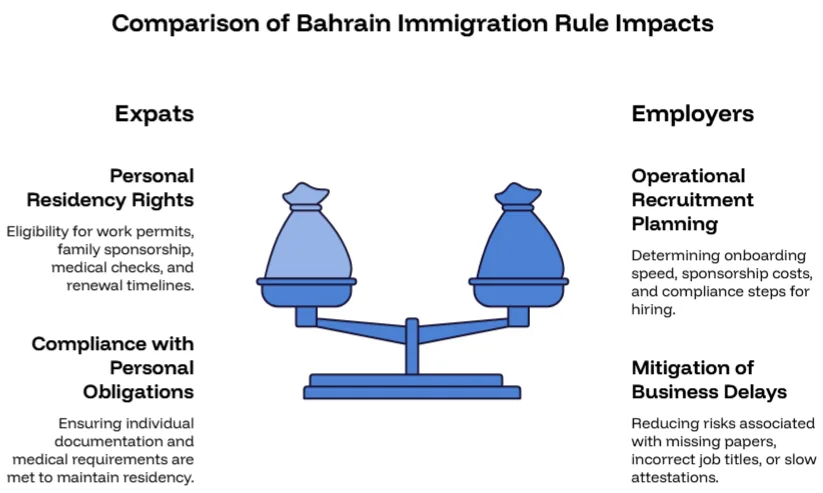
For expats, these regulations shape eligibility for work permits, family sponsorship, medical checks, and renewal timelines. For employers, they determine how quickly they can onboard talent, the cost of sponsorship, and the compliance steps needed to stay aligned with updated immigration laws.
Typical permit processing times range from 3–6 weeks, depending on documentation, quota availability, and nationality. Missing papers, incorrect job titles, or slow attestations often lead to delays.
If your business is expanding or you’re bringing in new staff, these updated rules help you reduce risk and improve hiring efficiency.
Key Immigration Rules for Expats
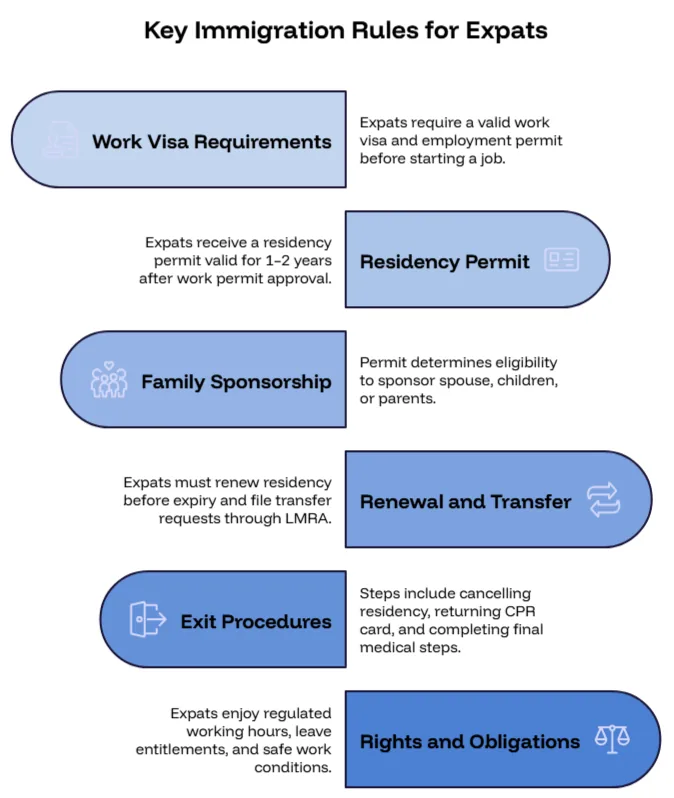
Expats moving to Bahrain in 2026 must navigate updated work, residency, and sponsorship regulations. Understanding these rules helps ensure a smooth relocation and legal compliance throughout their stay.
Work Visa & Employment Permit Requirements
Expats require a valid work visa and employment permit before starting a job. The Bahrain immigration rules enhance verification procedures to reduce mismatches between contracts, job titles, and submitted documents.
Eligibility:
- Valid passport.
- Confirmed job offer.
- Medical fitness clearance.
- Educational or professional credentials.
Employer responsibilities:
- Submit the work permit through LMRA.
- Maintain active commercial registration (CR).
- Provide accurate job titles.
- Pay labour and health insurance fees.
Employers must complete internal validation of documents before applying. LMRA also launched a faster approval route for high-skilled professionals. (Reference: Bahrain Ministry of Labour & LMRA)
Residency Permit & Family Sponsorship
Once the work permit is approved, expats receive a residency permit valid for 1–2 years. This permit determines whether you can sponsor your spouse, children, or in limited cases, parents via family sponsorship.
Key points:
- Sponsorship requires meeting minimum salary thresholds
- Marriage and birth certificates must be attested
- Processing takes 2–4 weeks
- Residency fees average BHD 60–100
- A 2026 rule requires dependents to complete biometric registration within 30 days of arrival.
Renewal, Change of Employer & Exit Procedures
Expats must renew their residency before expiry to avoid fines. Renewals usually finish quicker than first-time permits.
Changing employers:
- Transfer requests must be filed through LMRA
- New employer must begin the sponsorship transfer
- Approval determines the employee’s next steps
Exit steps:
- Cancel residency
- Return CPR card
- Complete final medical steps if necessary
Refer to LMRA guidelines for official renewal and exit procedures.
Rights and Obligations of Expat Employees
Expats enjoy regulated working hours, leave entitlements, and safe work conditions under Bahrain’s immigration laws and labour rules. In 2026, authorities emphasised stronger compliance checks to ensure employers follow contracts and maintain proper workplace standards.
Key Immigration Rules for Employers
Employers in Bahrain must follow updated regulations to hire, sponsor, and manage foreign workers legally. Understanding these rules ensures compliance, avoids fines, and streamlines the hiring and immigration process.
Employer Registration & Sponsorship Obligations
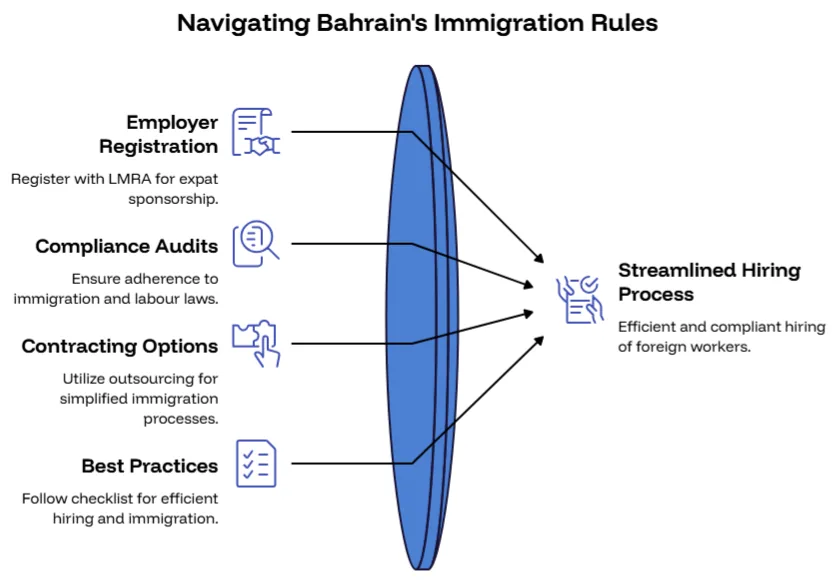
Employers must register with LMRA to sponsor expats.
Requirements include:
- Valid Commercial Registration
- Updated address and signatory
- Sponsorship fees
- Labour contributions
2026 updates:
- Revised quotas for select sectors
- Increased penalties (up to BHD 1,000) for hiring without proper sponsorship
- Mandatory annual compliance audits
Compliance, Audits & Penalties
Labour authorities perform regular audits to ensure employers follow Bahrain immigration rules and labour regulations.
Common violations include:
- Incorrect job roles
- Expired work permits
- Hiring without sponsorship
Typical penalties:
- BHD 500–1,000 for expired permits
- Higher penalties for repeat breaches
Contracting & Outsourcing Options
Employers in Bahrain can simplify their hiring and immigration obligations by using outsourcing or PEO services. These solutions handle work permits, residency processing, documentation, and compliance checks, reducing administrative workload and minimizing legal risks. If you’re still weighing whether outsourcing is the right call for your business, see our full breakdown of PEO pros and cons.
By partnering with a professional provider, companies save time, avoid errors, and ensure adherence to the latest Bahrain immigration rules. This approach is especially useful for businesses hiring multiple expats or managing seasonal and project-based staff.
Best Practices for Efficient Hiring and Immigration
Follow this checklist for smoother hiring:
- Start applications early
- Verify employee credentials
- Conduct internal compliance checks
- Track quota availability
- Review updated laws annually
Immigration Process Step-by-Step
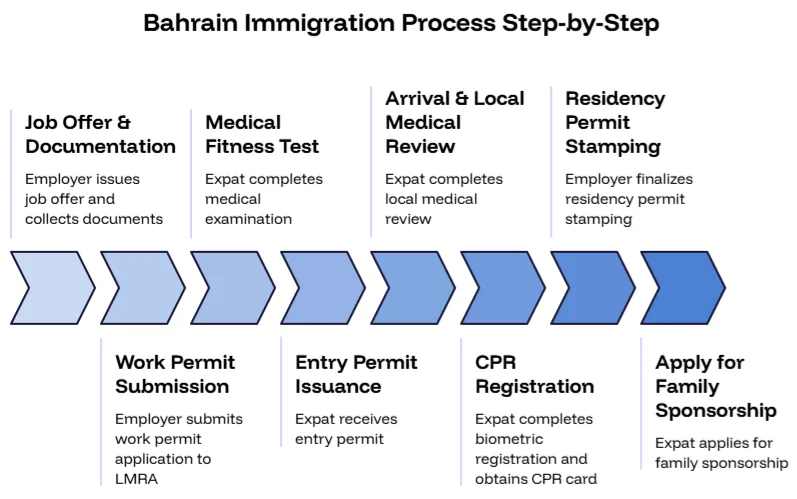
The immigration process in Bahrain follows a structured path. Here’s the full journey:
Step 1: Job Offer & Documentation
The employer issues a formal job offer to the candidate and collects all required documents, including passport copies, photographs, educational certificates, and the signed employment contract. Ensuring every document is complete and correctly attested at this stage helps prevent delays in later steps.
Step 2: Work Permit Submission
The employer submits the work permit application to LMRA for approval. Processing typically takes 3 working days as LMRA mentioned, depending on quota availability and document accuracy.
Step 3: Medical Fitness Test
The expat must complete a medical examination at a GAMCA-approved centre or an authorised clinic in Bahrain. Passing this test ensures compliance with health and safety requirements for foreign workers.
Step 4: Entry Permit Issuance
Once the work permit is approved, the expat receives an entry permit allowing legal entry into Bahrain. This permit is required before boarding flights or travelling to the Kingdom.
Step 5: Arrival & Local Medical Review
Some visa categories require a second medical check upon arrival in Bahrain. Completing this ensures the expat meets local health standards before starting work.
Step 6: CPR Registration
The expat must complete biometric registration and obtain a CPR card, which serves as their national ID. This step is mandatory for accessing healthcare, banking, and other services in Bahrain.
Step 7: Residency Permit Stamping
The employer finalises the residency permit stamping in the expat’s passport. This process usually takes 3–10 days and legally authorises the expat to reside and work in Bahrain.
Step 8: Apply for Family Sponsorship
Expats eligible to sponsor dependents can submit applications for spouses and children. This optional process typically takes 2–4 weeks, depending on documentation and quota availability.
Common Delays
Delays often occur due to incomplete attestations, quota limitations, medical retests, or incorrect job titles. Planning ahead and double-checking documents can help prevent these common setbacks.
Recent & Upcoming Changes
As Bahrain modernises its labour and immigration framework, several important updates have laid the groundwork for 2026. These changes reflect a shift toward digitalisation, regulatory clarity, and stronger compliance.
Below are the most relevant updates that expats and employers should know as they plan immigration under the new 2026 regime.
New 6‑Month Commercial Work Permits
As of February 2025, the Labour Market Regulatory Authority (LMRA) introduced a six‑month permit option for existing expatriates working in the commercial sector. This permit complements the traditional 1 and 2‑year work permits and gives businesses flexibility to engage short-term staff without long-term commitment.
Ban on Converting Visit Visas to Work/Dependent Visas Without Sponsor
Under updated rules (from 12 February 2024), individuals on visit visas cannot convert to work or dependent visas unless they have a valid sponsor. Stricter compliance and sector quotas for employers also apply — firms that exceed certain thresholds may face financial penalties or fines.
Digital‑First Application and Processing System
LMRA and associated authorities continue to strengthen e‑services and online permit processing, reducing paperwork and speeding up processing cycles.
Wage Payment & Labour‑Protection Upgrades
New rulings under 2025–2026 bolster wage protection and contractual transparency for expatriate workers, aiming to safeguard against delays or unfair treatment.
Summary of 2026 Updates
| Change | Impact | Effective Date |
|---|---|---|
| New employer quota rules | Limits per sector revised | Jan 2026 |
| Mandatory biometric registration for dependents | Improves accuracy of records | March 2026 |
| Higher fines for expired permits | Encourages timely renewals | Jan 2026 |
| Fast-track approval for specialized roles | Faster hiring | June 2026 |
These updates enhance transparency and support a more predictable immigration environment.
Costs, Timelines & ROI
Understanding the costs and timelines associated with Bahrain immigration is essential for both employers and expats. The 2026 updates make the process more predictable, but accurate planning ensures smoother hiring and relocation.
Typical Cost Breakdown
| Item | Paid By | Approximate Cost (BHD) | Details |
|---|---|---|---|
| Work Permit Fee | Employer | 100–200 | Depending on job category and sector |
| Residency Permit | Expats/Employer | 60–100 | Valid for 1–2 years |
| Pre-Employment Medical | Expats | 25–35 | Required for all foreign hires |
| CPR Card Registration | Expats | 10 | National ID for residents |
| Document Attestations | Expats | 20–80 | Certificates, degree, marriage/birth certificates |
| Sponsorship Fee | Employer | 50–100 | Annual fee for family or work sponsorship |
Average Timelines
Following the Bahrain immigration rules, most applications complete within 4–6 weeks, assuming documents are accurate and quotas are available.
Key steps that influence timing include:
- Employer submission of work permit.
- Medical clearance for expats.
- Residency permit stamping and CPR registration.
- Family sponsorship processing (optional, 2–4 weeks)
Being proactive in document preparation, quota planning, and early submission can prevent delays and unnecessary reapplications.
Return on Investment (ROI)
Investing in proper immigration compliance delivers tangible benefits:
- Faster hiring: Streamlined processing accelerates onboarding.
- Lower fine risk: Avoids penalties from expired permits or incomplete sponsorship.
- Improved compliance: Ensures alignment with 2026 immigration laws, reducing legal and operational risks.
- Operational efficiency: Outsourcing processes or working with a PEO allows HR teams to focus on business growth instead of administrative delays.
Employers who understand costs and timelines can better manage budgets, forecast project start dates, and ensure expats and their families have a seamless relocation experience.
FAQs
Can I sponsor my spouse or children?
Yes, if you meet the salary requirement and hold a valid residency. You must submit attested documents.
What if I change employers?
Your new employer must start the permit transfer. Work continues after LMRA approval.
How long does residency last?
Typically 1–2 years depending on your job and employer.
Will I need another medical exam?
Sometimes, especially if your last clearance expired.
Can my employer cancel my visa when I resign?
Yes, employers must cancel your permit before you exit or transfer sponsorship.
What if my permit expires while I’m abroad?
Your employer must renew it early or reapply depending on LMRA instructions.
For personalized assistance, reach out to PEO Middle East.
Why Choose PEO Middle East for Your Bahrain Immigration Needs
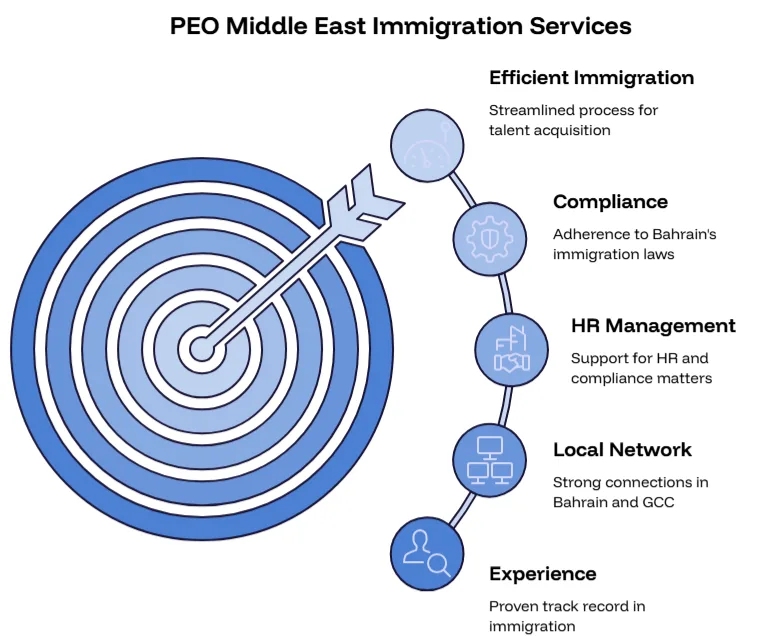
PEO Middle East has extensive experience handling immigration, HR, and compliance matters across Bahrain and the GCC. With a strong local network and a proven record — over 300 foreign hires processed in Bahrain in 2025 — their team helps businesses onboard talent quickly and lawfully.
From visas to sponsorship transfers and family applications, their specialists manage every step with accuracy.
Conclusion & Next Steps
The Bahrain immigration rules create a more structured, predictable environment for both expats and employers. With clearer rules and improved digital procedures, the journey becomes easier — especially with the right support.
Whether you’re planning to hire or relocate, now is the best time to organize your documentation and align your plans.