
Labour laws, immigration rules, and compliance requirements undergo constant changes to accurately reflect a country’s current policies and national development programs. But keeping up with all these updates can be eating away at your HR team’s time, stalling them from efficiently processing payroll. You can overcome this challenge by working with a reliable Professional Employer Organization. Partnering with the right PEO company means you can hire faster, confidently expand, and bring in more revenue.
If you are evaluating your options, we have a great resource for you. Here’s what we cover in this guide:
- What a PEO really does
- Choosing a PEO company: What’s in it for you
- How you can select the right service provider for your business
What Does a PEO Actually Do?
PEO stands for Professional Employer Organization. It is a company that manages your company’s core employment operations through either of these 2 models:
- Co-employment
- Employer of record
This means that they take over heavy or repetitive admin tasks, such as payroll, tax filings, benefits and compliance. Meanwhile, you retain control of your daily operations and performance.
A modern PEO usually handles payroll processing, benefits administration, HR support, onboarding, contracts, local labor compliance, and risk management. Many also provide international employer of record (EOR) services if you are hiring across borders. This helps you legally hire people without having to open a local entity.
Growing tech startups and product teams wanting to scale often use this model. They get to hire quickly without recruiting an entire in-house HR department.
PEO vs EOR: What’s the Difference?
Earlier we discussed that PEO manages employment operations for your business using either of these 2 structures: co-employment or EOR.
In a co-employment model, you and your PEO share responsibility. You manage your employee while PEO manages the employment backend tasks like payroll, taxes, and benefits. Whereas, in an EOR model, your EOR provider becomes the legal employer of your workforce. They hire and pay the employee on your behalf, which is significantly resourceful when you do not have a legal entity in that country.
How and where you are hiring affects which one is the right structure for you.
Who Benefits from PEO Company Services?
Almost any growing company can leverage PEO services. If your company is spending too much time on admin or worrying about labor laws instead of customers, you are a strong candidate too.
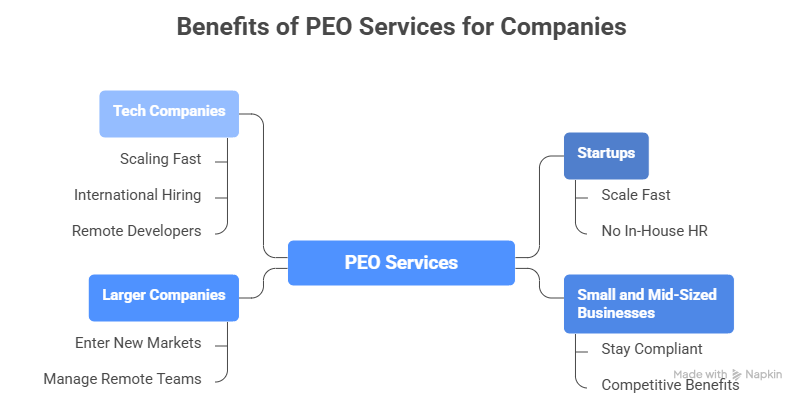
Here’s how PEO services can benefit companies of different sizes:
- Startups can scale fast and don’t need to build an in-house HR team when they use PEO.
- Small and mid sized businesses rely on PEO services to stay compliant and competitive on benefits.
- Larger companies have an easier time entering new markets quickly or manage their remote international teams when they work with a PEO.
Research consistently shows that companies working with PEOs experience lower turnover and faster growth. When employees get reliable payroll and solid benefits, morale improves. When leaders have room to focus on things other than compliance issues, strategy improves. That’s what makes it a win-win solution.
Since compliance and payroll complexity can snowball overnight, PEO services are especially valuable for tech companies that are scaling fast, hiring across borders, or managing remote developers.
Core Benefits of a PEO: What’s in it for You?
A good PEO makes it easier for you to manage employees and set up in previously unexplored markets. There are a lot of advantages to working with a PEO:
- Efficient Payroll:
They streamline payroll and taxes so salaries are paid correctly and on-time. Deductions and filings are accurately handled. This keeps payroll stress-free especially for tech firms that are running lean teams or paying contractors and engineers in multiple countries.
- Better Benefits:
Since PEOs pool many clients together, they negotiate stronger health insurance, retirement plans, and other perks that small teams usually cannot access alone.
- Risk Mitigation:
Compliance risks are reduced by PEOs. Labor laws, visas, contracts, and local regulations are constantly changing. A PEO tracks this for you so you do not accidentally get into legal trouble.
In highly regulated sectors of fintech, SaaS, or health tech, one compliance mistake can stall funding rounds or expansion plans, which is why many tech founders lean on a PEO early.
- Time Saving:
A PEO saves time so your leadership and HR team can focus on hiring great people and building culture. If you are not getting similar outcomes, you are probably not working with the right partner.
How You Can Choose the Right PEO Company for Your Business?
Choosing a PEO company involves trusting a service provider with your people, payroll, and legal exposure. That’s why selecting the right one is such an important decision that impacts your business in the long run.
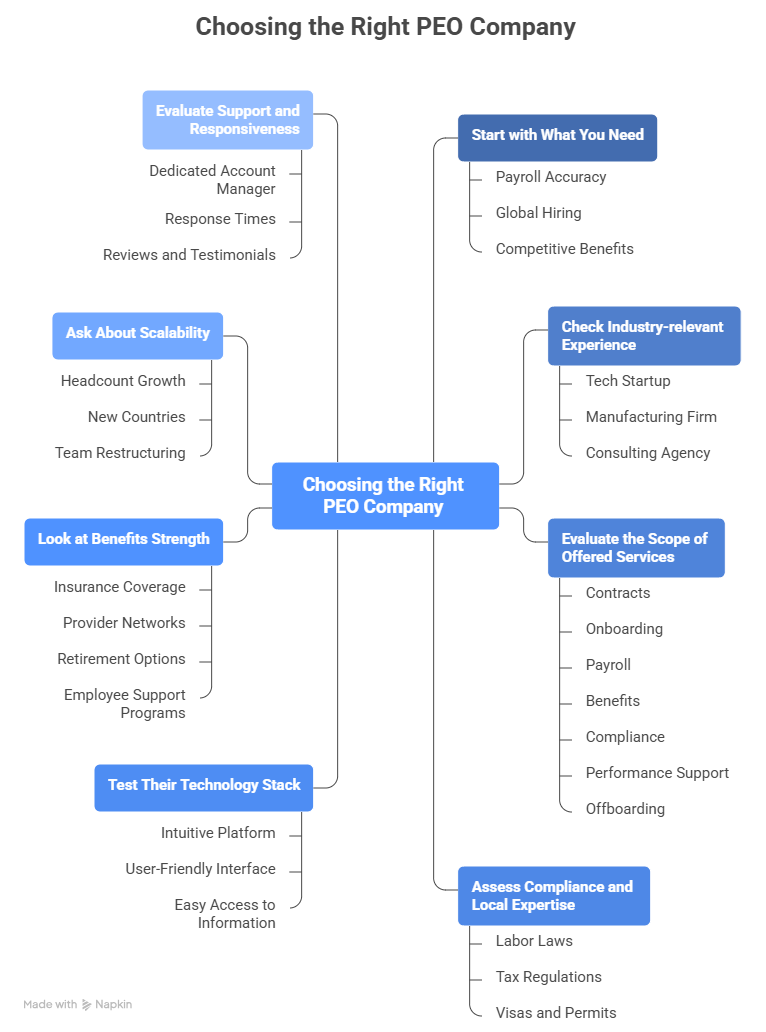
You can find the one most suitable for your business by following these steps:
-
Start with What You Need:
Pin what you are actually struggling with. Is it payroll accuracy, hiring internationally, or competitive benefits? Do you want someone to completely manage compliance on your behalf? Or are you simply lacking HR bandwidth.
If you are a tech company, your priorities might include fast onboarding, equity friendly payroll support, and the ability to hire globally without setting up entities in every market.
The companies you shortlist as your potential PEO provider should match your priorities.
- If global hiring is your goal, you should make sure they provide employer of record (EOR) services.
- If benefits are what matters most, compare their plan quality.
- If it’s speed you are after, ask them about their onboarding timelines.
-
Check Industry-relevant Experience:
All PEOs won’t understand every business model the same way. That’s why it’s better to choose one that has experience in your industry.
A tech startup, a manufacturing firm, and a consulting agency have very different needs. Look for providers who already support companies like yours. They will understand roles, compensation structures, and growth patterns without a steep learning curve. That experience saves you time and mistakes.
-
Evaluate the Scope of Offered Services:
Some providers will only handle payroll while others will offer you full service HR. Ideally, your PEO company should cover contracts, onboarding, payroll, benefits, compliance, performance support, and offboarding.
-
Assess Compliance and Local Expertise:
If you are setting up in unfamiliar grounds, you need local expertise. Moreover, experience really matters with legal compliance. You can assess if they are the right fit by asking them these questions:
- How do they stay updated on labor laws and tax regulations?
- Who handles audits and government queries?
- How do they manage visas or permits for hiring internationally?
If their answers sound vague, it’s better to walk away and move on to assess the next one on your list.
-
Test Their Technology Stack:
Your employees will be using their platform daily. So it should be intuitive and user-friendly.
Look for a clean HR portal where staff can view payslips, benefits, and leave balances easily. Managers should be able to approve requests and access reports without jumping through hoops.
Good software will save you hours every month. Whereas, bad software quietly drains productivity.
-
Look at Benefits Strength
Strong employee benefits help attract and retain top talent. However, many providers claim to offer great benefits. What really matters is the quality and value of those offerings. Compare the factors below to identify a reliable PEO company.
- Insurance Coverage.
- Provider Networks.
- Retirement Options.
- Employee Support Programs.
-
Ask About Scalability
Your business today is not going to be the same business next year. Make sure the PEO company can support you if you double your headcount, enter new countries, or restructure your teams.
-
Evaluate Support and Responsiveness
You will need quick support if there’s ever any issue with payroll or compliance. So ask them beforehand whether you will get a dedicated account manager. Check their response times.
Service quality matters far more than pricing. Read their reviews and testimonials and if it’s possible, talk to their existing clients.
Don’t Make these Mistakes When You Are Choosing a PEO Company.
You should never make these mistakes when you are selecting a PEO company for your business:
- Going with the cheapest option
- Ignoring compliance depth
- Overlooking technology
- Assuming all PEOs are the same
A low cost provider that misses filings or pays employees late will cost you far more in the long run. Always choose value, reliability, and expertise over a short term bargain.
Why Many Growing Companies Partner with PEO Middle East?
If you are expanding across the region or hiring international talent, working with a provider that understands local regulations makes a real difference.
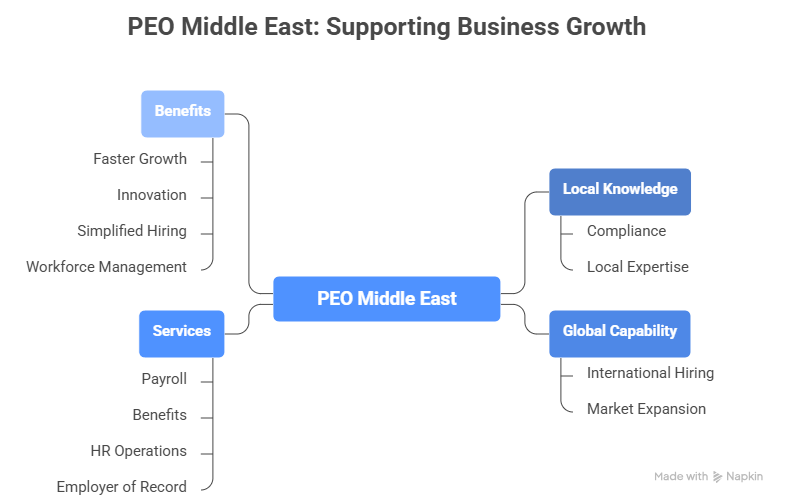
At PEO Middle East, we support startups scaling tech teams, SMEs, and larger teams with compliant payroll, benefits, HR operations, and employer of record services across multiple markets. You get local knowledge with global capability, so you can grow faster and stay fully compliant without slowing down your innovation.
If you want a simpler way to hire, pay, and manage your workforce, reach out for a consultation and see how the model fits your goals. Contact us now for our services.
FAQs
Is a PEO the same as an HR outsourcing company?
Not exactly! A PEO usually works through a co-employment or EOR structure and takes on legal and compliance responsibilities.
Can small businesses use a PEO?
Small and mid sized companies often benefit the most by using a PEO. That’s because they gain enterprise level HR support without building an internal team.
Does a PEO control my employees?
No. You still manage your day to day work, performance, and culture. The PEO handles the employment administration in the background.
How quickly can we start with a PEO?
Many providers can onboard within days or weeks. A good PEO should give you a clear timeline upfront.